
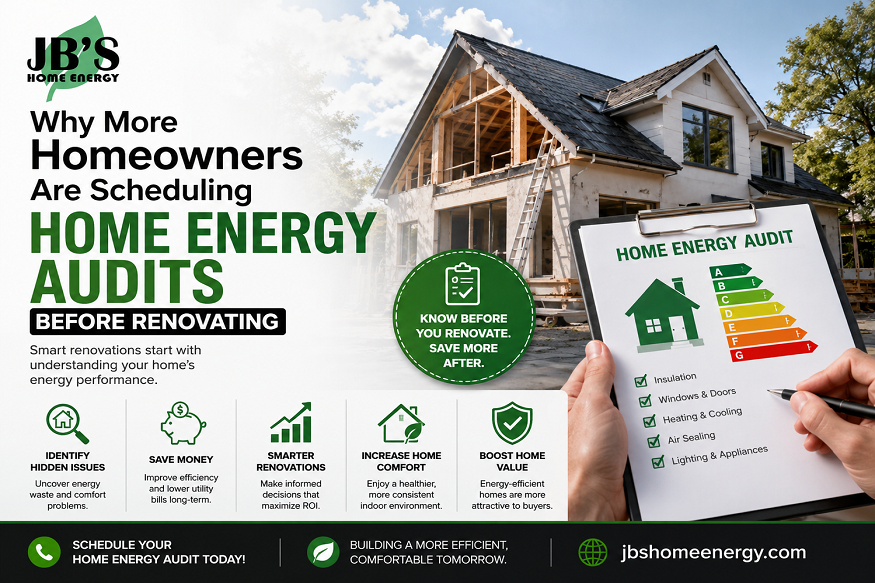
Homeowners are scheduling an energy audit before renovating because it shows exactly where a house wastes energy, which keeps renovation budgets from going toward the wrong fixes. Instead of guessing whether new windows or added insulation will lower a heating bill, an audit measures airflow, heat loss, and equipment performance first. That information decides which upgrades come first and which ones can wait.
What Does a Home Energy Audit Actually Check?
A trained auditor walks through the home, reviews a year of utility bills, and inspects insulation, ductwork, windows, and the heating and cooling system. Diagnostic tools such as a blower door and an infrared camera locate air leaks that stay invisible during a normal walk-through. Homeowners scheduling a home energy audit Massachusetts or other places where contractors often learn that attic bypasses and rim joists account for more heat loss than an aging furnace does.
Why Should You Renovate After the Audit?
Renovating first and auditing later tends to waste money. A homeowner who insulates a wall before sealing the air leaks behind it locks the problem inside the structure. Contractors who see the audit report first can sequence drywall, insulation, and mechanical work correctly, which avoids reopening finished walls later.
For anyone comparing a home energy audit New Hampshire that homeowners rely on against one in a milder climate, cold-weather air sealing matters even more, since gaps in the envelope cost more over a longer heating season.
Expert Insight
Efficiency programs and typical savings vary by state. The figures below reflect current utility and state-run programs in each region.
| State | Program | Assessment Cost | Typical Savings Potential |
| Massachusetts | Mass Save Home Energy Assessment | No cost for eligible utility customers | 5%-30% on energy bills after recommended upgrades |
| New Hampshire | NHSaves Home Energy Performance (HPwES) | About $100 co-pay for the assessment | Roughly 10%-20% off heating and cooling costs |
| Ohio | AEP Ohio HELP program / utility Home Energy Check | Free for income-qualified households; paid options vary by contractor | Varies by upgrade, since Ohio eliminated its statewide mandated efficiency programs under House Bill 6 |
How Does an Audit Change Renovation Decisions?
Once the report is in hand, decisions get simpler. Air sealing and insulation upgrades usually come first because they cost less than a new furnace and often let the existing system perform well enough to delay a full replacement. Homeowners renovating a commercial property or preparing a building for corporate meetings follow the same logic, since HVAC sizing depends on how well the building holds conditioned air.
Read More: Preparing Your Home for Fall: Why August Is the Perfect Time to Replace Old Windows
What Should Homeowners Look For in an Audit Provider?
A quality provider explains findings in plain language and backs every recommendation with blower door and duct test numbers. If you’re ready to schedule an assessment and have started searching for a home energy audit Ohio or in nearby areas, look for a company that separates urgent fixes from upgrades you can plan for later.
Conclusion
An energy audit turns a renovation plan into a data-backed project instead of a guess. Homeowners are using audit results to prioritize the upgrades that actually lower bills and improve comfort, rather than spending on the wrong fixes first. That single step often changes the entire order of a renovation.
Whether the project is a kitchen remodel, a full building upgrade, or a lower energy bill, JB’s Home Energy provides home energy assessments, air sealing, and duct sealing for residential homes and commercial properties nationwide. Schedule an audit before the next renovation begins and build the plan on real data.
Frequently Asked Questions
Q: What is the difference between a preliminary and a detailed energy audit?
A preliminary audit is a walk-through review of utility bills, visible insulation, and obvious problem areas. It moves quickly and costs less, but stays surface level. A detailed audit adds diagnostic testing, including a blower door test and infrared scanning, to measure air leakage and heat loss precisely, then delivers a report that ranks upgrades by cost and payback.
Q: Which step of a residential energy audit focuses on the building’s thermal envelope?
The air leakage testing step, typically done with a blower door and an infrared camera, focuses on the thermal envelope. It measures how much conditioned air escapes through walls, attics, windows, and foundation gaps, which shows the auditor where insulation and air sealing will make the biggest difference.
Read More: August Pest Alert: What Columbus Homeowners Should Watch For
Q: How long does a home energy audit take?
A standard residential visit runs about two to four hours. Larger homes, commercial buildings, and audits that include detailed diagnostic testing can take longer, sometimes spanning a full day.